When people talk about the founding of Nashville, one name usually comes first: James Robertson. That makes sense. He led the overland party into the Cumberland country and helped establish the settlement that became Fort Nashborough.
But Nashville was not built by one journey alone.
It took a second expedition, one that gets far less attention and may have been even more difficult. That journey belonged to John Donelson.
If Robertson’s winter crossing brought the first foothold, Donelson’s voyage brought the families, tools, provisions, and people needed to turn a precarious outpost into a real community. Without that river expedition, the Cumberland settlement might not have held.
And the more you look at Donelson’s story, the more remarkable it becomes.
He Was More Than a Supporting Character
John Donelson is often mentioned as if he were simply part of someone else’s story. He was not.
Born in Virginia in 1718, Donelson was older than many of the frontier leaders we usually associate with Tennessee’s early settlement. He had already built a full life before the Cumberland expedition. He worked as a surveyor and planter, and he had experience in public affairs. By the time he joined the westward movement into what would become Tennessee, he was not a young adventurer looking for opportunity. He was a seasoned man moving his family into uncertain country because he believed in the future of the frontier.
That matters. It changes how we see the journey.
This was not a reckless dash into the wilderness. It was a calculated move made by people who understood the risks and took them anyway.
If you read my article on the founding of the Cumberland settlements, you already know how high the stakes were. Nashville did not begin as a city with a plan and a street grid. It began as a gamble in dangerous country. James Robertson’s party made the first move. John Donelson’s flotilla made the settlement possible.
The Journey Started on the Holston
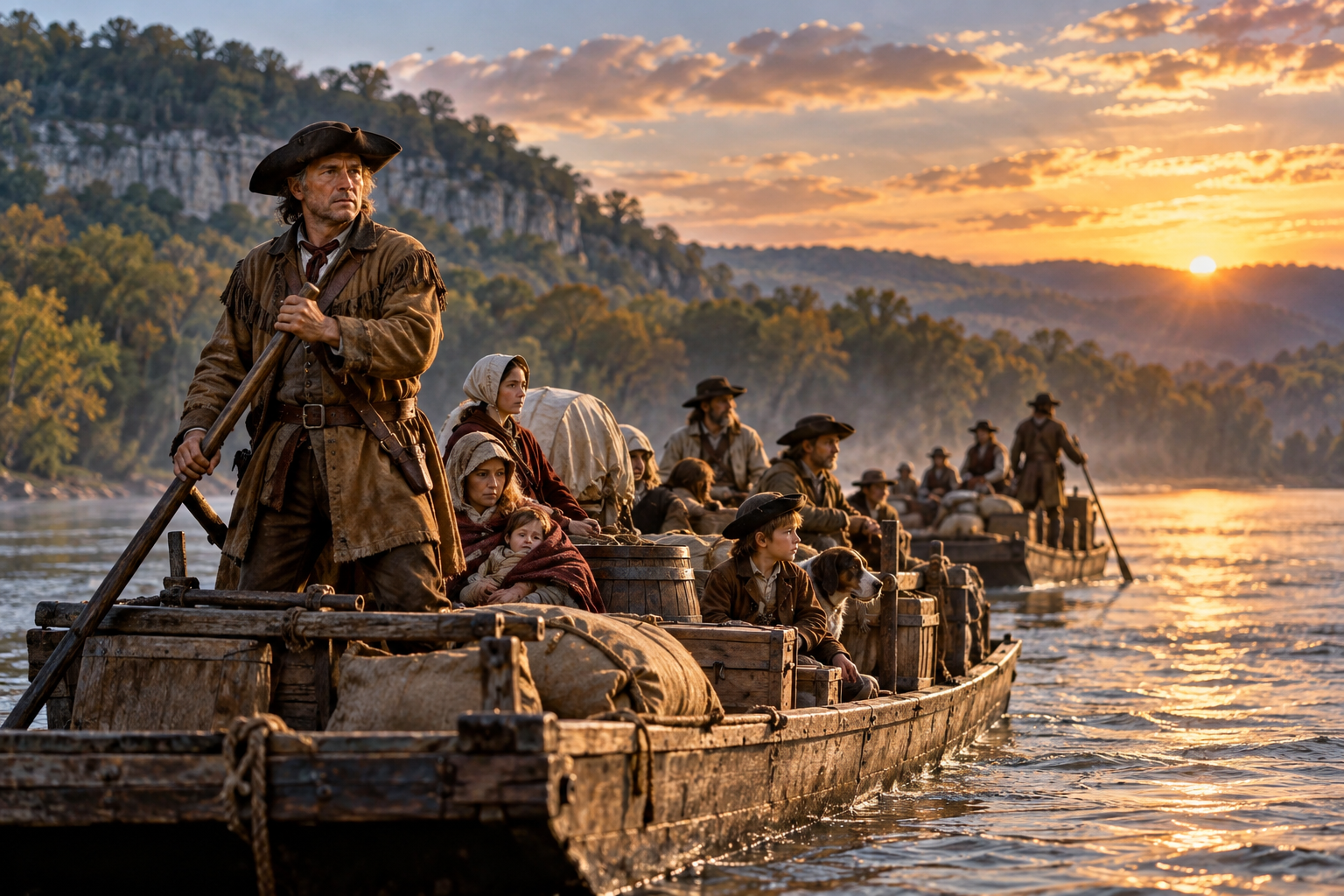
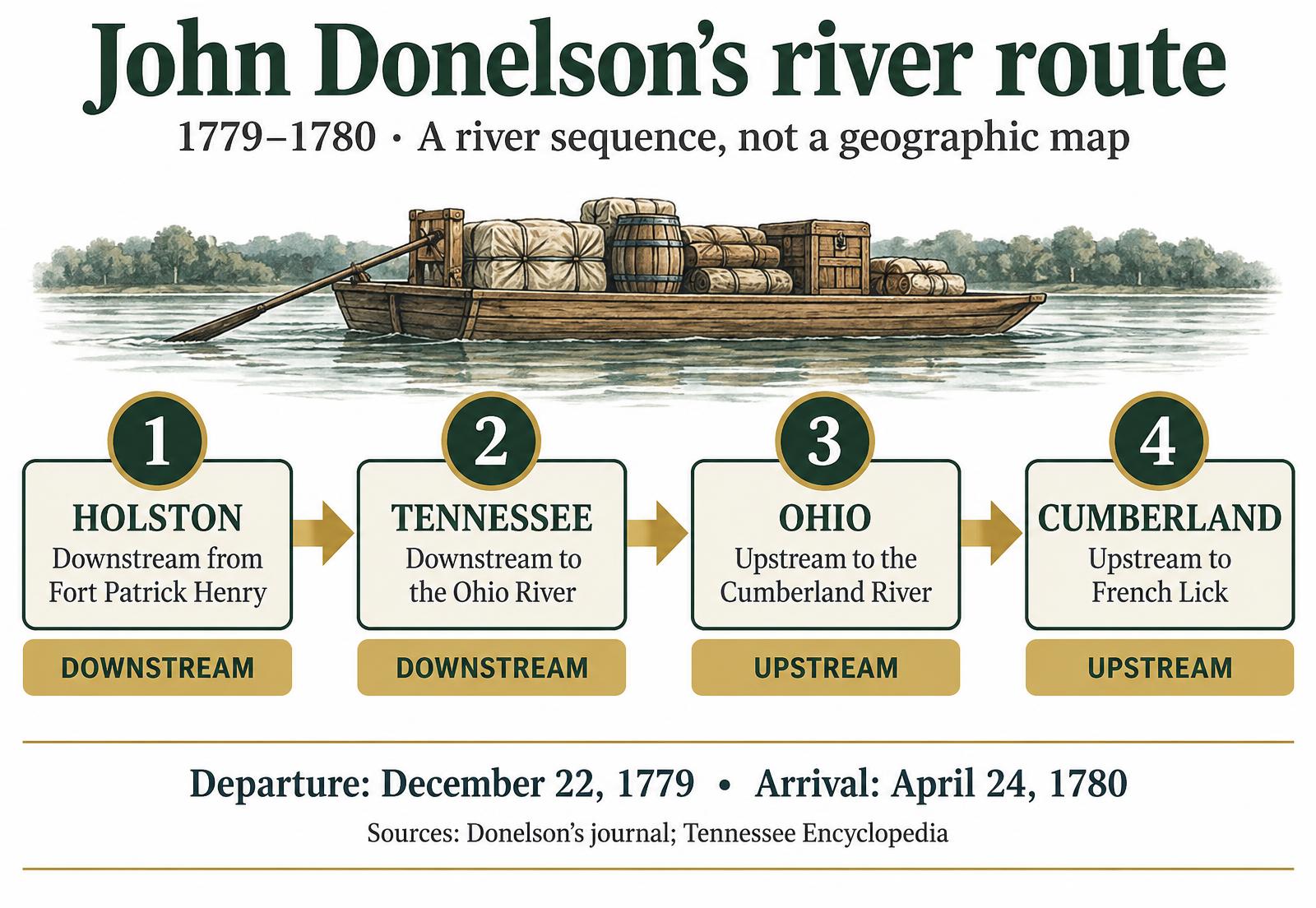
Donelson’s expedition left from Fort Patrick Henry on the Holston River in December 1779. He led a flotilla of boats carrying women, children, supplies, and several families bound for the Cumberland settlement.
That detail alone sets his trip apart from Robertson’s.
Robertson’s party was largely male and overland. Donelson’s included entire households. This was not simply a scouting mission or a military movement. These were families on the move. They were bringing the materials of ordinary life into extraordinary circumstances.
Among those on the journey were Donelson’s own family members, including his daughter Rachel, who would later become Rachel Donelson Jackson, wife of Andrew Jackson. Also traveling with the party were Charlotte Robertson and several of her children, making their way to join James Robertson at the Cumberland settlement.
It is easy to compress that into one sentence and move on. We should not.
Think about what it meant to load children, household goods, livestock, food, and hopes for a new life onto flatboats in the dead of winter and begin a journey of roughly one thousand miles through river systems that were unfamiliar, dangerous, and often unforgiving.
That is not a side note in Tennessee history. That is one of its central stories.
Donelson Kept a Record of the Hardship
One reason this journey stands out is that John Donelson left behind a journal. That gives us something rare in early Tennessee history: a firsthand record of what the party faced.
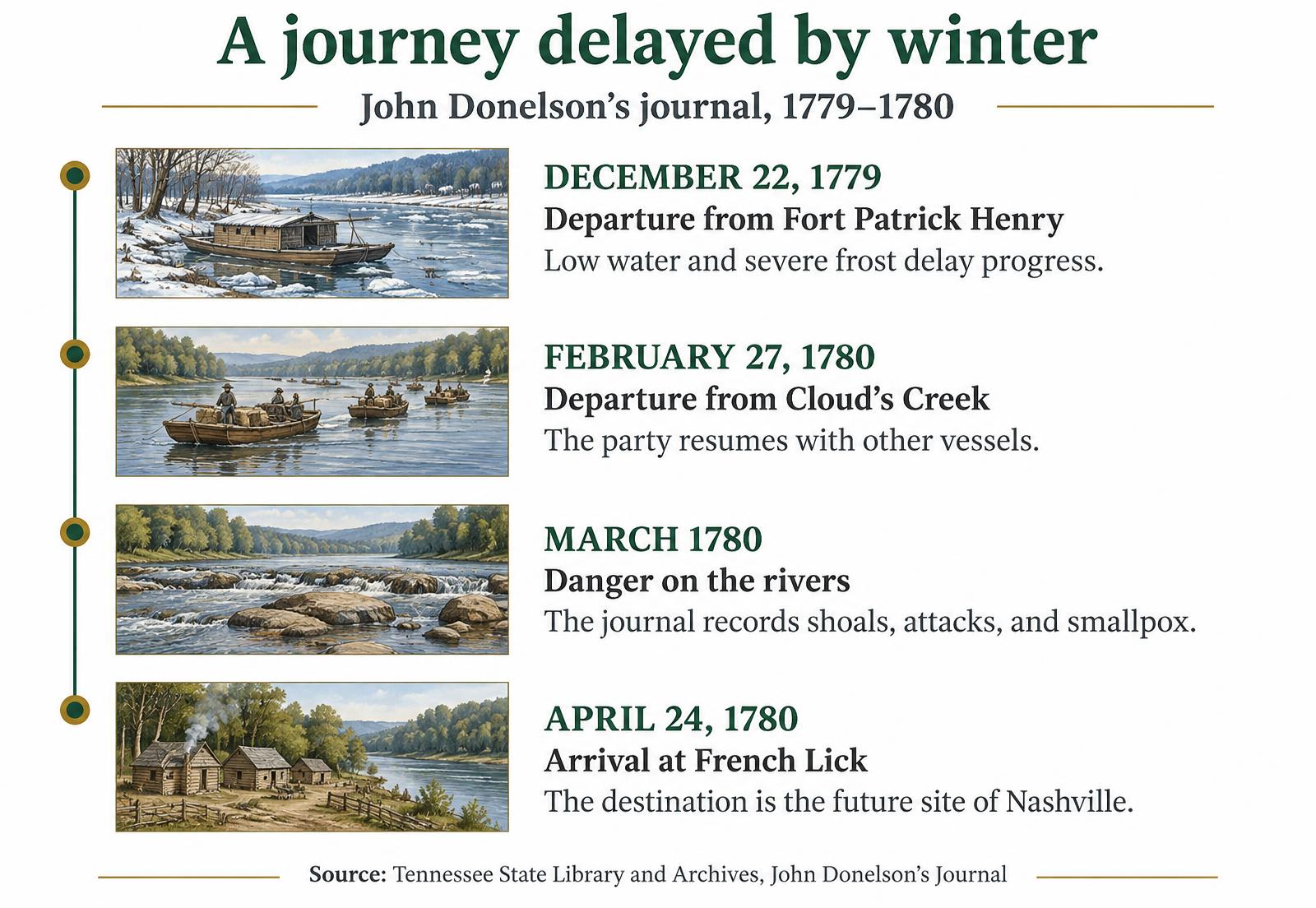
He described the cold, the currents, delays, illness, and attacks. He did not write as a dramatist. He wrote as a man trying to get his people safely to the next bend in the river.
That plainness makes the story even more powerful.
The trip followed a difficult route. The flotilla moved down the Holston River into the Tennessee River, then westward, eventually connecting to the Ohio River before turning into the Cumberland and heading toward French Lick, the site that would become Nashville.
On paper, that route may sound direct. In reality, it was anything but simple.
The party faced exhaustion, hunger, freezing weather, and the constant uncertainty of what waited ahead. River travel in the late eighteenth century was not smooth or predictable. Low water, swift current, shoals, and hostile encounters could turn a day’s progress into a day’s survival.
And there was no backup plan waiting downstream.
The Frontier Did Not Pause for Families
One of the things that strikes me most about this story is how little mercy the frontier offered.
Modern readers sometimes imagine settlement history as a sequence of brave departures and inspiring arrivals. The truth was harsher than that. Families got sick. Children suffered. Food ran short. Travel took longer than expected. Every delay increased the risk.
Donelson’s party dealt with smallpox during the voyage. They also had to remain alert for attacks. A faction of Cherokee opposed the settlers’ movement into the Cumberland region, especially after the disputed Transylvania land claims and the continuing pressure of white settlement. The frontier was not empty land waiting to be claimed. It was contested ground, and everyone on the river knew it.
That is one reason the journey deserves to be told carefully. It was not just difficult because of nature. It unfolded inside a larger conflict over land, sovereignty, and survival.
That context also connects to another part of Tennessee’s early political history. In The Watauga Association, I wrote about how settlers in East Tennessee created structures of local government when formal authority was weak or distant. The people pushing westward into the Cumberland country carried that same instinct with them. They were not only looking for land. They were building social and political order as they went.
Why This Journey Mattered So Much
Robertson reached the Cumberland first with the overland party in late 1779. He and his men established the initial position and prepared for the arrival of the rest.
But a settlement made up mostly of men cannot become a permanent community without support, supplies, and families. That is where Donelson’s voyage changed everything.
When his flotilla arrived at French Lick in April 1780, it brought what the frontier most needed: continuity.
The arrival helped anchor the settlement. It connected the outpost to home life, domestic labor, food preparation, child-rearing, and the ordinary rhythms that make a place livable. The fort and cabins mattered, of course. So did defense. But survival on the Tennessee frontier depended just as much on the quieter work of building households and sustaining them.
This is one of the reasons I think John Donelson deserves more attention than he usually gets. He helped carry not just settlers, but society.
Without that, Fort Nashborough might have remained fragile for much longer.
The Cumberland Compact Followed Quickly
Within days of the settlers’ arrival, the Cumberland settlement took another major step. In May 1780, leaders adopted the Cumberland Compact, a governing document that helped organize civil life in the new settlement.
That document matters because it shows how quickly frontier communities moved from survival to structure. They were not content to live indefinitely in uncertainty. They wanted a workable framework for land claims, dispute resolution, and public order.
The Cumberland Compact belongs in the same conversation as Donelson’s voyage because the two are connected. One brought people into the settlement. The other gave those people a way to govern themselves.
If that sounds familiar, it should. Tennessee’s early history is full of moments like this. The settlers of the State of Franklin also acted when they believed distant government was not meeting local needs. That same theme runs through much of the state’s frontier story: communities making institutions before official approval catches up.
He Helped Found More Than a Town
It is tempting to reduce John Donelson’s legacy to one famous river trip. But his place in Tennessee history is broader than that.
He was part of the generation that helped transform the western Carolina frontier into organized communities that would eventually become Tennessee. His family would remain deeply tied to the state’s political and cultural history. Through his daughter Rachel, his name became linked to Andrew Jackson and the later national story of Tennessee’s rise in American politics.
But I think that later fame sometimes obscures the earlier achievement.
Before the Hermitage, before Andrew Jackson, before presidential connections, there was a dangerous winter voyage and a man trying to bring families safely to the Cumberland.
That is the part I do not want lost.
Donelson’s Story Gives Nashville a More Complete Beginning
Nashville’s founding story is stronger when we tell all of it.
James Robertson absolutely deserves the recognition he receives. He earned it. I explored that more fully in James Robertson, Father of Middle Tennessee. But the founding of a permanent settlement required more than a single leader and a single route. It required coordination, endurance, and people willing to move by both land and water into a region where success was far from guaranteed.
John Donelson was central to that effort.
His voyage reminds us that frontier settlement was not only about exploration. It was about transport, logistics, leadership, and the ability to move whole families through hostile conditions toward a place they hoped would become home.
That is a more grounded story than the simplified version many of us learned.
It is also a more human one.
Why He Still Matters
I think John Donelson matters today because he represents a type of founder history often overlooked. He was not the loudest figure. He was not always placed at the center of the legend. But he helped make the legend real.
His journey made settlement durable. His leadership helped bridge the distance between aspiration and permanence. And his journal gives us one of the clearest windows into what early Tennesseans actually endured to build a future in the Cumberland country.
That is no small contribution.
The next time Nashville’s origins come up, James Robertson should absolutely be part of the conversation. But John Donelson should be there too.
He did not just travel to the frontier.
He helped carry Tennessee there.