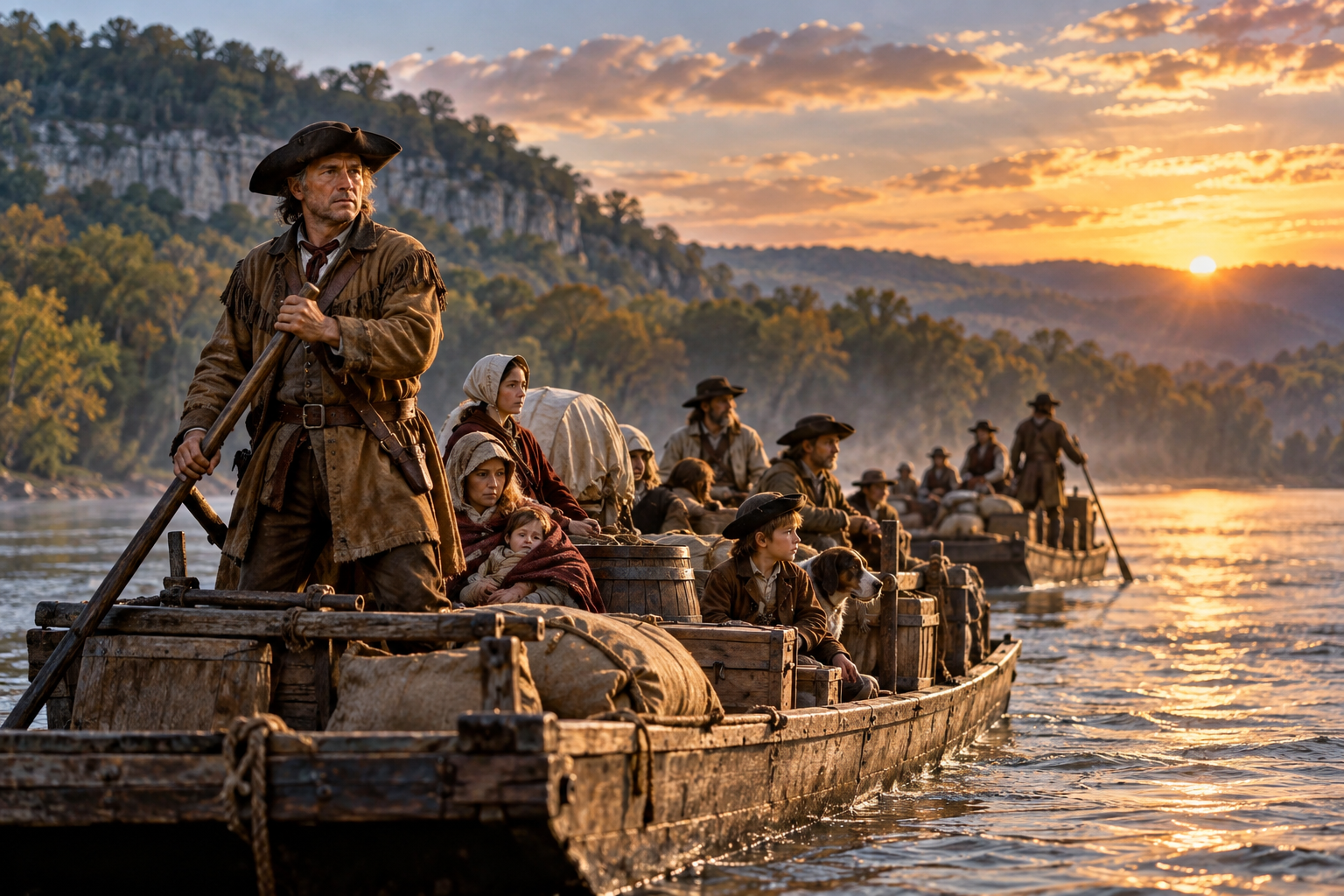

For many families in towns like Carthage, Lebanon and Chestnut Mound, the Tennessee Maneuvers were the moment World War II arrived on their own land. Army convoys rolled past farmhouses, soldiers camped in pastures and pontoon bridges spanned the Cumberland River. This guide explains what happened, why Middle Tennessee was chosen, and how the story is being kept alive today.
Tennessee Maneuvers: quick facts
| When | 1941–1944 (the main series ran from September 1942 to March 1944) |
|---|---|
| Who | The U.S. Second Army and rotating Army divisions and corps |
| Headquarters | Cumberland University, Lebanon, Wilson County |
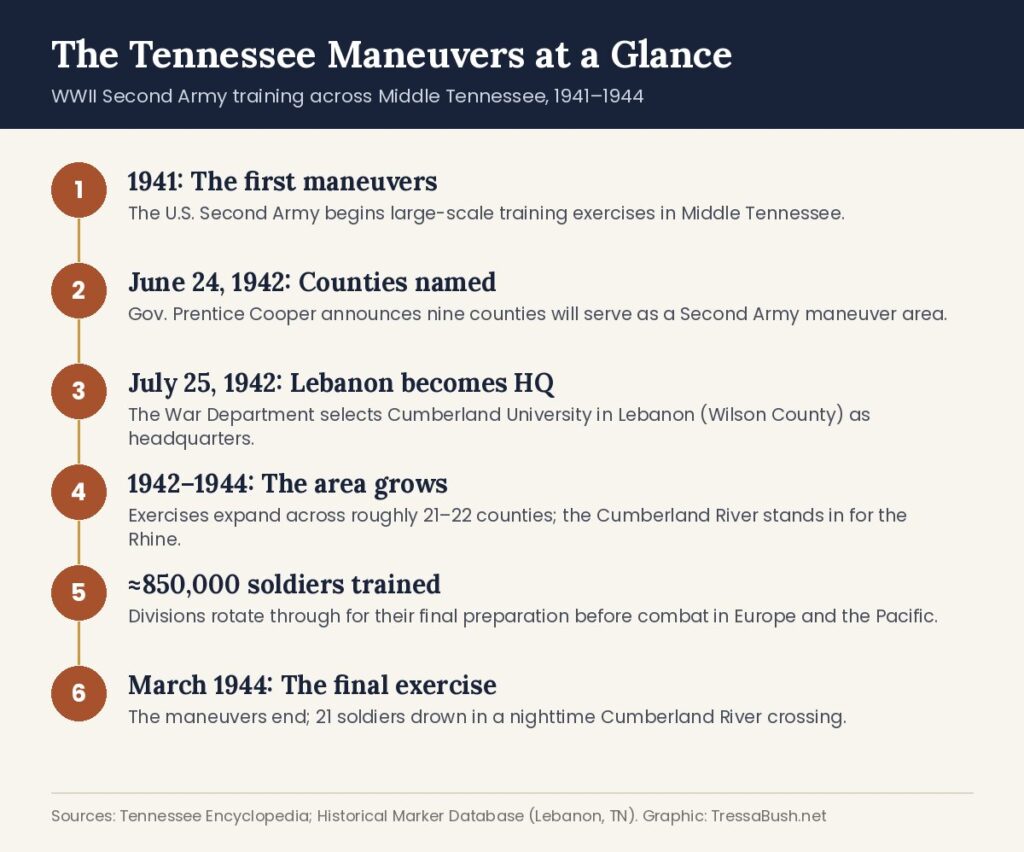
| Area | Began with nine counties in 1942; grew to roughly 21–22 counties of Middle Tennessee |
| Soldiers | About 850,000 by most marker counts; nearly one million by some estimates |
| Main railhead | Nashville |
Why the Army chose Middle Tennessee
By 1942 the Army needed a place where whole divisions could practice moving, attacking and defending over long distances, in conditions close to what they would face in Europe. Middle Tennessee fit. The rolling hills, valleys, farmland and small towns resembled the countryside of France and Germany, and the Cumberland River could stand in for the Rhine. The National Weather Service in Nashville, in a historical look back at the period, notes that the terrain was chosen because it resembled Western Europe.
Political support helped as well. Tennessee Governor Prentice Cooper and U.S. Senator Kenneth McKellar both encouraged the Army to hold the exercises in the state. On June 24, 1942, Governor Cooper announced that nine counties would be used as a Second Army maneuver area. A month later, on July 25, the War Department selected Cumberland University in Lebanon as headquarters.
How the maneuvers worked
The exercises were organized as a series of “problems,” or simulated battles. Soldiers were divided into two opposing forces, commonly called the Red and Blue armies, and spent days at a time attacking, defending, building bridges and moving supplies. According to the Tennessee Encyclopedia, the third problem of each phase often pitted attacking Blue troops against Red defenders around Donelson in Davidson County and Couchville in Wilson County.
Infantry, armored units, airborne troops and aircraft all took part. Divisions rotated through for what was often their final preparation before shipping out. Lebanon, as headquarters, became the nerve center, while Nashville served as the main railhead where troops and equipment arrived.
Wilson County: headquarters of the maneuvers
Lebanon and Wilson County sat at the center of the operation. Cumberland University, which had fewer than 200 students enrolled in the fall of 1941, became Army headquarters for the field exercises. A short-term encampment and airfield were also set up at what is now Lebanon Municipal Airport.
Today, historical markers on the Cumberland University campus explain the headquarters’ role and honor the university’s students who served. They are among the most accessible places to start learning about the maneuvers in person. Tressa Bush, who worked for years in Wilson County media, has recorded an audio story on Wilson County’s connection to the maneuvers, available on her writing and publications page.
Smith County and the Cumberland River crossings
Because the Cumberland River played the role of a major European river, river crossings were a key part of the training. Pontoon bridges were built across the Cumberland at several points, including between Lebanon and Gallatin and at Carthage, the county seat of Smith County.
River crossings were also among the most dangerous parts of the training. On the final night of the last exercise in March 1944, 21 soldiers drowned when their assault boat overturned while crossing the flood-swollen Cumberland north of Lebanon. A marker in Lebanon remembers them. More broadly, Tennessee Magazine has reported that more than 250 soldiers died while stationed in Tennessee during the maneuvers, most in vehicle accidents, plane crashes and failed river crossings.
Life on the home front
For local families, the maneuvers were not distant history. Farmers signed agreements allowing troops onto their land. Convoys filled two-lane roads, and soldiers camped in fields and near small towns, sometimes for weekends at a time. Residents in many communities offered meals, water and a place to rest.
Those everyday encounters are the stories Tressa set out to collect when she founded the Smith County Historical Tourism Society in 2021. As she has written, the kindness and hospitality of local families rarely appear in official reports, but they were an important part of how the region experienced the war.
“They were neighbors. And they were heroes, too.”
Tressa Bush, on the families who hosted soldiers during the maneuvers
How the Tennessee Maneuvers are remembered today
Several efforts keep the story visible:
- Historical markers in Lebanon, including those at Cumberland University, explain the headquarters and honor those who died.
- Tennessee Maneuvers Remembered, organized by the Smith County Historical Tourism Society and led by Tressa Bush, is an annual living-history event in Carthage. The 2025 event was held on May 3.
- Family stories and local research continue to add detail about life during the maneuvers, especially from communities that were not well documented at the time.
How to explore this history yourself
- Visit Lebanon. Start with the historical markers at Cumberland University.
- Drive the Cumberland River corridor through Wilson and Smith counties to see the landscape the Army used.
- Attend Tennessee Maneuvers Remembered in Carthage for a hands-on look at the era.
- Record a family story. If an older relative remembers the maneuvers, write it down or record it, then consider sharing it with the Smith County Historical Tourism Society through the contact page.
Sources
- Second Army (Tennessee) Maneuvers, Tennessee Encyclopedia, Tennessee Historical Society
- World War II 2nd Army Maneuvers in Tennessee marker, Historical Marker Database (Lebanon, TN)
- The WWII Years at Cumberland marker, Historical Marker Database
- A Tornado During Military Operations, National Weather Service Nashville
- The Tennessee Maneuvers, The Tennessee Magazine