
Tennessee history · Early settlements
The Watauga Association: Tennessee’s First Experiment in Frontier Government
In 1772, families living beyond the reach of colonial government built a court of their own. The result was practical, short-lived, and far more complicated than the legend it inspired.
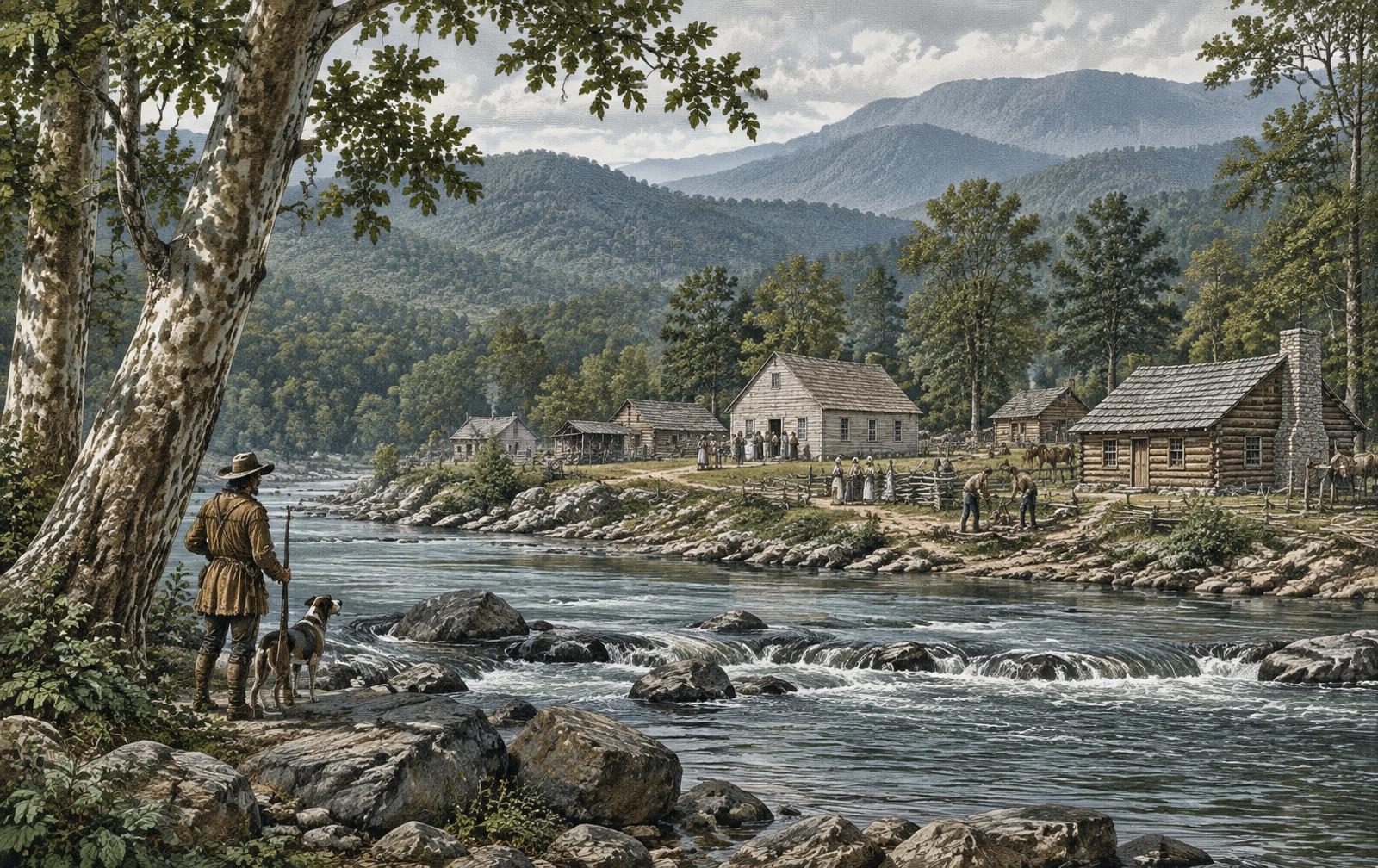
Before Tennessee was a state—and before the short-lived State of Franklin—settlers along the Watauga River faced a basic question: who would settle disputes, record agreements, and keep order when the nearest recognized government did not reach them? Their answer was the Watauga Association, a local government organized in 1772 in what is now Northeast Tennessee.
The association is often praised as an early expression of self-government west of the Appalachian Mountains. That description captures part of its importance. It can also hide two essential facts: the settlement stood within land recognized as Cherokee territory, and the association’s founding document has not survived. To understand what happened at Watauga, we have to hold achievement, uncertainty, and dispossession in the same frame.
Formed
Settlers organized the association in 1772 along the Watauga River.
Structure
Five elected magistrates formed a court for local government.
Key limit
No copy of the association’s written articles is known to survive.
Before the Watauga Association: a settlement outside the line
By 1772, roughly 70 farms or homesteads stood along the Watauga River, according to the Tennessee Encyclopedia. The river valley lay in present-day Carter County. At the time, however, it sat outside organized British colonial government and within territory recognized as Cherokee land.
The boundary problem was not a technicality. The Royal Proclamation of 1763 had restricted colonial settlement west of the Appalachian divide. Later surveys and agreements still left the Watauga settlement beyond the accepted line. Instead of leaving, settlers negotiated a 10-year lease with Cherokee representatives in 1772.
That lease did not erase the conflict at the center of the arrangement. European settlers wanted permanent farms and land claims. Cherokee communities faced accelerating encroachment on a homeland governed through their own towns, leaders, and diplomatic systems. The association’s story is therefore not the beginning of government in the region. It is the story of one settler government created inside an older Indigenous political landscape.
How a five-person frontier court worked
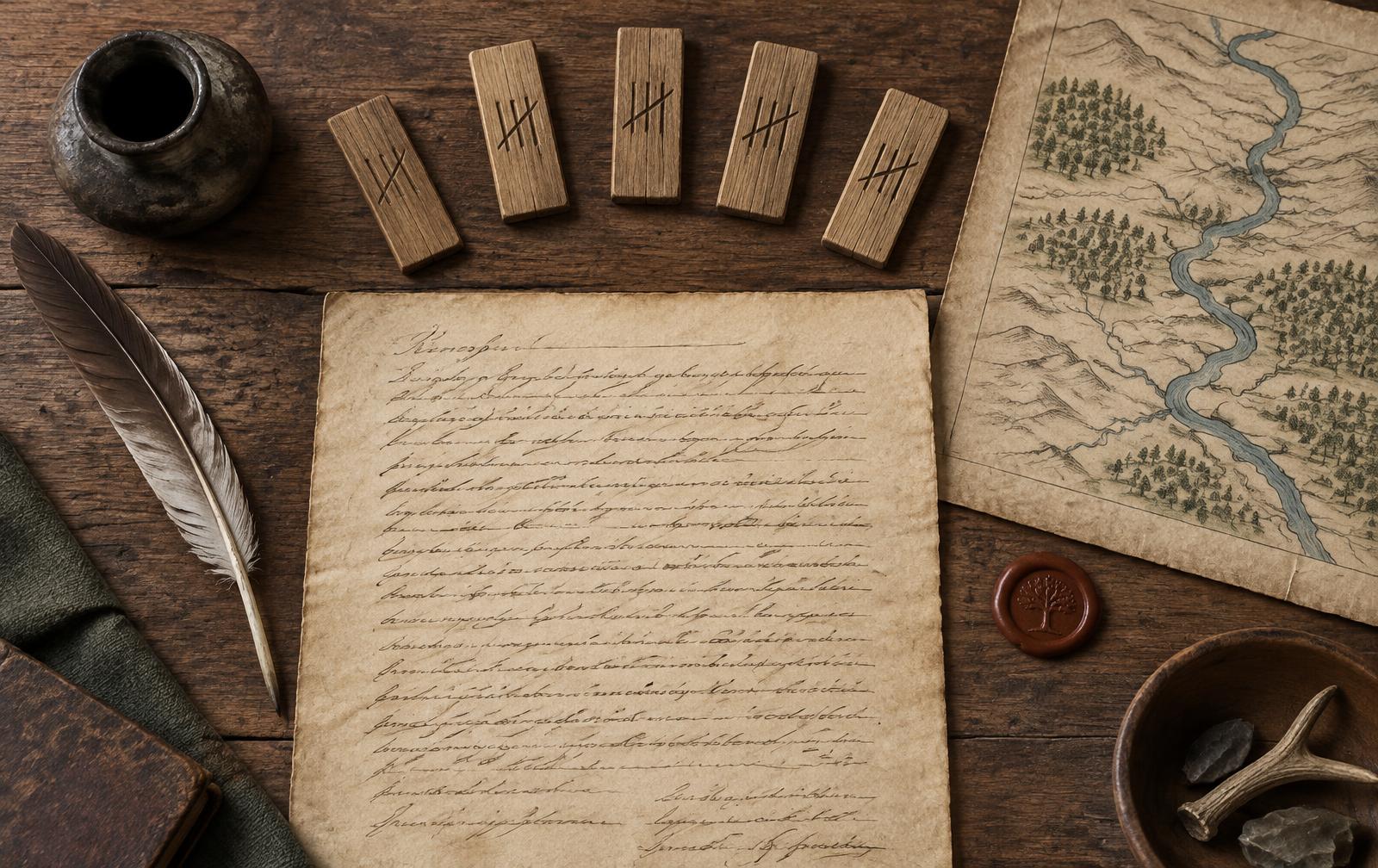
The settlers adopted written articles and drew on Virginia law. Five elected magistrates formed a court. A clerk kept records, while a sheriff carried out judgments. In one small body, the court handled duties we would now divide among executive, legislative, and judicial offices.
This was less a grand declaration of independence than a response to everyday needs. Someone had to recognize contracts, settle property disputes, hear lawsuits, and organize public safety. Because the community adopted an existing legal code, the magistrates likely spent more time administering and judging than writing new laws.
Community
Settlers needed a way to manage disputes and shared risks.
Articles
Written rules adapted an existing Virginia legal framework.
Court
Five magistrates handled local government and justice.
The identities of the first five magistrates are not fully certain. Historians generally place John Carter and James Robertson among the leading figures, but surviving evidence does not support a definitive original roster. That matters because neat lists can make a fragmentary record look complete.
James Robertson’s role at Watauga also forms the opening chapter of his later work in Middle Tennessee. His move west helped connect the Watauga experience to the dangerous effort that founded the Cumberland settlements and Nashville. Read alongside the account of James Robertson’s life, the association shows where he first practiced frontier leadership.
The Cherokee land beneath the familiar story
Older retellings often frame Watauga as an empty frontier where settlers invented democracy. It was not empty. Cherokee people had long-standing towns, hunting grounds, travel routes, and systems of government across the southern Appalachians.
The 1772 lease was followed by a much larger and more controversial transaction at Sycamore Shoals in March 1775. Richard Henderson’s Transylvania Company negotiated for an enormous tract covering parts of present-day Kentucky and Tennessee. The private purchase violated British rules, and North Carolina later rejected Henderson’s claim. Dragging Canoe, a Cherokee leader who opposed the sale, warned against continued settlement.
This is where careful language matters. Saying that “the Cherokee sold the land” suggests a single people made a simple, final decision. In reality, Cherokee leaders did not all agree, colonial law disputed private purchases, and land pressure continued after every agreement. The Treaty of Sycamore Shoals became influential, but it did not create uncontested ownership.
The Watauga story contains two truths at once: settlers created a working local court, and they did so while expanding into Cherokee territory.
What survives—and what does not
The association’s fame exceeds its surviving paper trail. No known copy of its founding articles remains. The Washington County Archives explains that the association had no courthouse or permanent records office. Only a small group of related documents has survived, including a court case and a later petition.
Missing
Limited
Survives
Survive
This is a qualitative guide to the record, not a count of documents.
That absence limits what historians can claim. We know the association used written articles because later accounts and records describe them. We know a five-member court operated. We do not have the original text to compare line by line with a modern constitution.
The phrase “first free and independent government” became popular in later commemorations. It is safer to call Watauga an early, locally organized settler government. The residents were solving the absence of colonial administration; the available evidence does not show that they declared independence from Britain in 1772.
From Watauga to the Revolution, Franklin, and Tennessee
The association itself lasted only a few years, but the same place and many of the same people appear throughout Tennessee’s founding era.
-
Watauga Association
Settlers create written articles and a five-magistrate court.
-
Sycamore Shoals
The Transylvania land negotiations reshape settlement pressure across the region.
-
Washington District
Residents petition North Carolina for formal recognition and protection.
-
Overmountain muster
Patriot militia gather at Sycamore Shoals before marching to Kings Mountain.
-
State of Franklin
Western counties launch another, larger experiment in self-government.
-
Tennessee statehood
The region becomes part of the sixteenth state.
In 1776, Watauga residents petitioned North Carolina to accept their district. North Carolina created Washington District that year and Washington County in 1777. This move reminds us that the settlers did not simply keep building an independent republic. They sought attachment to an established state government.
Four years later, men from the western settlements gathered at Sycamore Shoals before crossing the mountains to fight at Kings Mountain. The story of the Overmountain Men follows that campaign and explains why the battle became one of Tennessee’s strongest links to the American Revolution.
John Sevier belonged to this same network of settlements and frontier government. His path from militia leader to governor is explored in John Sevier: Tennessee’s First Governor and “Nolichucky Jack”. After North Carolina later ceded its western lands, Sevier helped lead the failed State of Franklin—an effort that echoed Watauga’s desire for government closer to the people it served, but on a larger and more openly political scale.
Why the Watauga Association still matters
The Watauga Association matters because it reveals how government can grow from immediate needs. A remote community needed courts, records, and collective decisions. Its residents borrowed familiar law and built a small institution that worked for several years.
It also shows why origin stories deserve scrutiny. Later generations turned Watauga into a clean tale of democratic firsts. The surviving evidence is thinner than that legend. The Cherokee context is more central. And the association’s eventual request to join North Carolina complicates claims of complete independence.
None of that makes the story less important. It makes it more useful. Watauga links the personal histories of Robertson and Sevier to the Overmountain campaign, the State of Franklin, and Tennessee statehood. It also demonstrates how local events in the Watauga Valley connected to larger national turning points.
The short version
The Watauga Association was a practical settler government formed in 1772, not a miniature state with a complete surviving constitution. Its five-member court helped govern a community beyond colonial administration, on land recognized as Cherokee territory. Its people and place later shaped the Revolution, the State of Franklin, and Tennessee.
Sources and further reading
This article favors archival and public-history sources and separates documented facts from later tradition. The illustrations are original interpretive artwork; they do not depict specific surviving Watauga documents or buildings.
- Tennessee Encyclopedia. “Watauga Association.”
- Washington County Archives. “Watauga Association Era Documents.”
- Tennessee Encyclopedia. “Sycamore Shoals State Historic Area.”
- Tennessee State Museum. “The Treaty of Sycamore Shoals.”
- Tennessee Encyclopedia. “Fort Watauga.”
- NCpedia. “Watauga Settlement.”
Primary topic: Watauga Association. Related topics: Watauga settlement, early Tennessee history, Sycamore Shoals, frontier government, John Sevier, James Robertson, and the State of Franklin.