A few minutes of television can make a small Tennessee town feel like a place worth visiting. Getting there takes more than a camera.
Over nearly two decades, Tressa Bush’s assignments for Tennessee Crossroads, the Nashville Public Television series, have taken her to sorghum mills on the Cumberland Plateau, guitar workshops in Wartrace and historic sites in the Upper Cumberland. Here is what that work has taught her.
Why small-town stories matter
A segment about a country store or a family craft may seem small, but these stories do important work. They preserve skills and traditions that are disappearing. They give residents pride in where they live. And they give travelers a reason to turn off the interstate and spend time, and money, in rural communities.
That connection between storytelling and visiting is the same idea behind Tressa’s historical tourism work in Smith County: when a story is told well, people want to see the place for themselves.
How a TV feature story comes together
Every segment follows a similar path, from the first tip to the final edit.
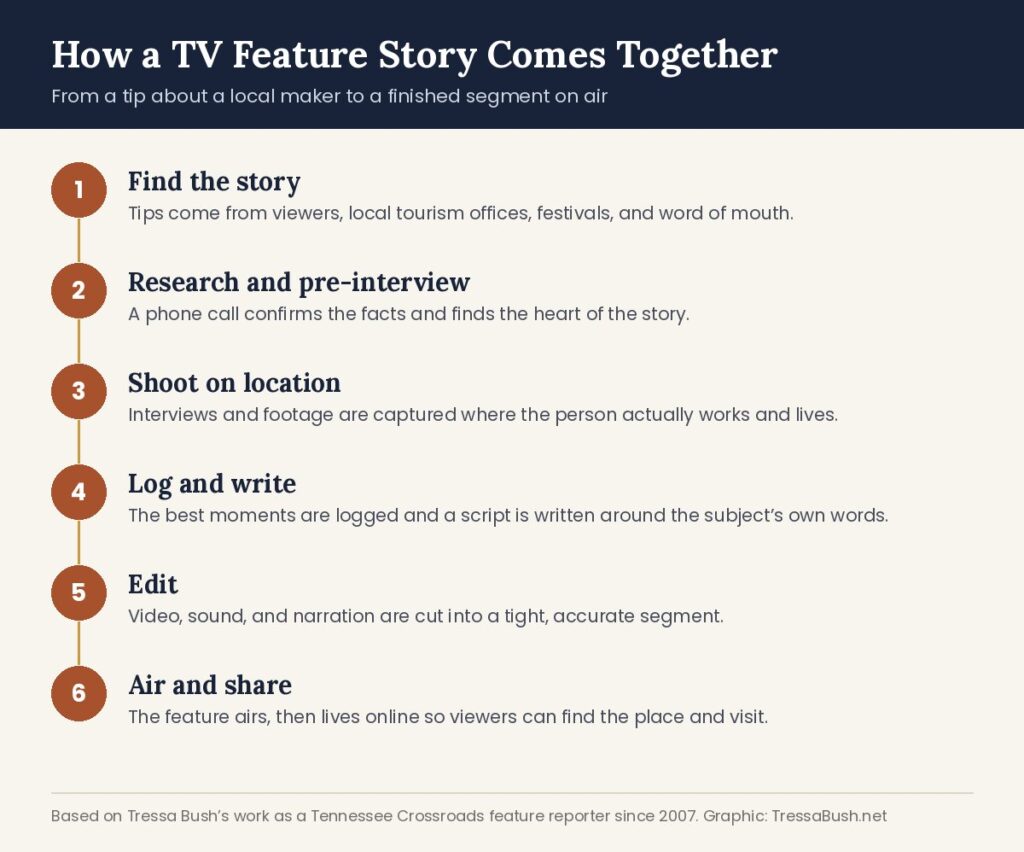
- Find the story. Tips come from viewers, local tourism offices, festival calendars and word of mouth.
- Research and pre-interview. A phone call confirms the facts and helps find the heart of the story.
- Shoot on location. Interviews happen where people actually work and live, so the setting tells part of the story.
- Log and write. The best moments are noted and the script is built around the subject’s own words.
- Edit. Video, natural sound and narration are cut into a tight, accurate segment.
- Air and share. The feature airs and then lives online, where viewers can find it long after.
Lesson 1: Let people tell it in their own words
The person in the story knows it better than any reporter. A good interview is mostly listening. When a sorghum maker explains why the syrup has to be skimmed at just the right moment, or an artist describes the first time she worked with clay, those words carry more weight than any narration.
Lesson 2: Show the place
Tennessee’s landscapes, workshops and storefronts are characters in their own right. Shooting on location, with the creak of a store’s wooden floor or the steam rising from a cooking pan, lets viewers feel like they have been there.
Lesson 3: Respect the time a craft takes
Many of the people Tressa has profiled practice crafts that take hours or days: coiling pine needle baskets, threading beadwork, building a guitar. A story should give viewers a sense of that patience instead of rushing past it. Often the slow parts are what make audiences appreciate the finished work.
Lesson 4: Get the details right
Names, places, dates and how something is made all need to be correct. Small errors undermine trust, especially in small communities where everyone knows the people involved. Checking details before a story airs is part of respecting the people who shared their time.
Lesson 5: Make the story an invitation
The best feature ends with viewers knowing how to find the place: the town, the season it is open or the festival weekend. A story is most useful when it leads somewhere.
From television to the printed page
Tressa has said that feature writing is her favorite kind of work, and the lessons carry over to print. When she wrote a Carthage Courier feature on Smith County bowler Lance Key, who has rolled 21 perfect games, she found that the story was not only about sports. It was about family, Smith County roots and a person quietly excelling close to home. You can find more of her writing on the writing and publications page.
Five Tennessee Crossroads stories worth watching
- Forbus General Store — a classic Upper Cumberland country store.
- Alvin C. York Historic Area — the home ground of a famous World War I hero in Pall Mall.
- Muddy Pond Sorghum — old-fashioned syrup making on the Cumberland Plateau.
- World’s Largest Treehouse — a hand-built landmark near Crossville.
- Pine Needle Baskets — a patient, traditional Tennessee craft.
Watch all five on the Tennessee Crossroads page.
How to suggest a story from your community
If you know a maker, a place or a tradition in Middle Tennessee that deserves attention, a few details make a story idea easier to consider:
- Who the person is and what they do, in a sentence or two.
- Where they are located and when visitors can see the work.
- What makes the story unusual, visual or meaningful.
- How to contact the person, with their permission.
You can share ideas through the social media profiles on the Contact page. Not every idea can become a feature, but every one is read.