
When a highway closes, a new driver license rule takes effect or a safety campaign launches, someone has to explain it clearly to millions of people. That is the job of a Public Information Officer.
Tressa Bush, who joined the Tennessee Department of Safety and Homeland Security as a Public Information Officer in 2026 after nearly two decades as a television feature reporter, explains the role here in general, plain-language terms.
This article describes public information work in general. It is not an official statement or guidance from the Tennessee Department of Safety and Homeland Security. For official department information, visit tn.gov/safety.
What is a Public Information Officer?
Most public agencies, from city police departments to state departments, have at least one PIO. The title varies; you may also see “communications officer,” “public affairs officer” or “spokesperson.” The core responsibility is the same: help the public get information that is accurate, timely and easy to understand.
A PIO serves two audiences at once. One is the public, who need to know what is happening and what, if anything, they should do. The other is the news media, who carry that information to a much wider audience and need reliable answers on deadline.
What does a PIO do day to day?
A typical week can include a wide mix of tasks:
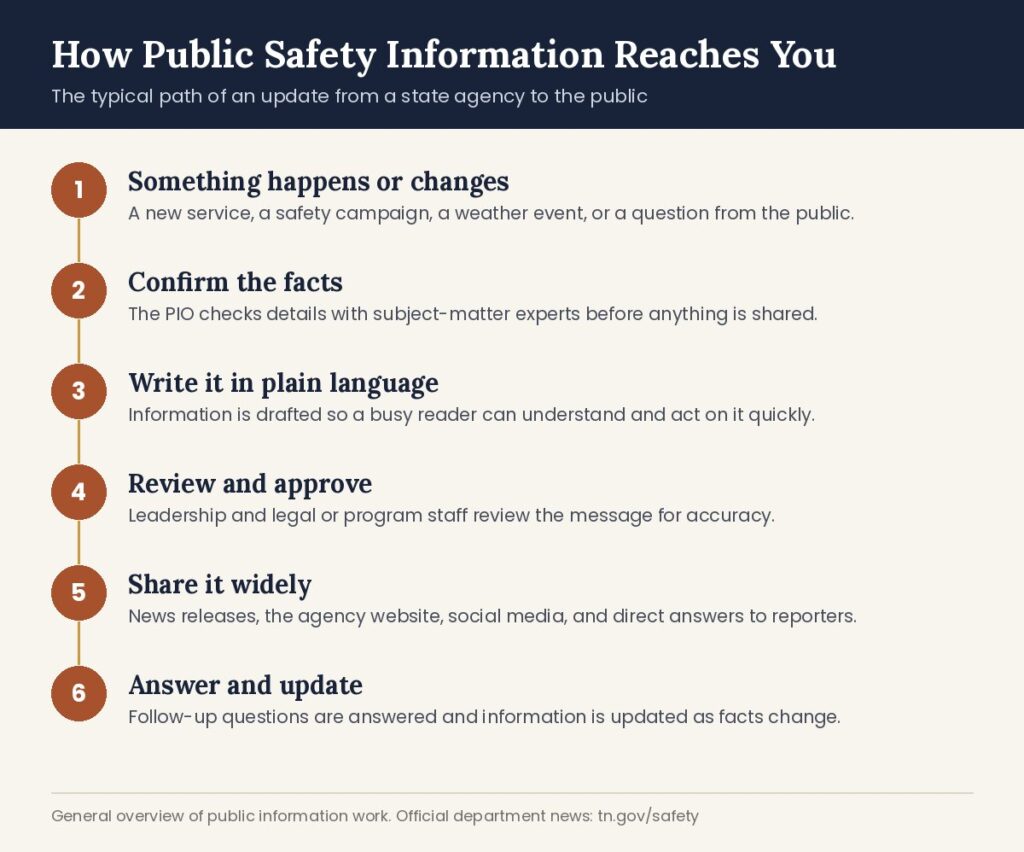
- Writing news releases about new services, safety campaigns, events and changes that affect the public.
- Answering media inquiries by gathering facts from the right experts and responding clearly.
- Arranging interviews with leaders or specialists who can speak to a topic.
- Updating websites and social media so information is consistent everywhere the public might look.
- Supporting public awareness campaigns, such as efforts to reduce distracted or impaired driving.
- Monitoring questions and misinformation so confusing or false claims can be addressed with facts.
What happens during an emergency?
During a major incident, such as severe weather or a large highway closure, the PIO’s job becomes even more important. Under the National Incident Management System (NIMS) used by agencies across the country, the Public Information Officer is part of the command staff in the Incident Command System. That means public information is treated as a core part of the response, not an afterthought.
When several agencies respond together, their PIOs may coordinate through a joint information center so the public hears one consistent message instead of conflicting ones. The priorities are simple to state and hard to do under pressure: share what is confirmed, explain what people should do, correct errors quickly and update as the situation changes.
How to tell official information from rumors
One of the most useful things anyone can do is learn where official information comes from. A few habits help:
- Go to the source. Official State of Tennessee websites end in tn.gov. The Department of Safety and Homeland Security publishes news at tn.gov/safety.
- Check the account. On social media, confirm that a post comes from an agency’s verified, official account before sharing it.
- Be wary of unexpected texts. Scammers sometimes send messages that look like they come from state services. The department has publicly warned Tennesseans about fake text messages made to look like they came from an official app. When in doubt, do not click the link; go to the official website instead.
- Look for a date. Old information gets reshared. Make sure an update is current.
- Trust local news that cites official sources. Reputable outlets name where their information comes from.
What skills make a good Public Information Officer?
Many PIOs come from journalism, and for good reason. The skills overlap almost completely:
- Accuracy. Confirm every detail before it goes out.
- Plain language. Replace jargon with words people actually use.
- Calm under deadline. Breaking news does not wait.
- Listening. Understand what people are actually asking.
- Relationships. Reporters and the public need to trust that the PIO will give straight answers.
Tressa’s background reflects that path: a broadcast journalism education at Middle Tennessee State University, years as a producer, writer and editor at Wilson County Television, and work as a Tennessee Crossroads feature reporter since 2007. Read more on her public service page.
Tips for reporters working with a PIO
- Share your deadline up front so the PIO can prioritize.
- Send specific questions; they are easier to answer accurately.
- Ask what can be confirmed now and when more information is expected.
- Use official releases and websites as a starting point for background.
Sources
- Communications Office, Tennessee Department of Safety and Homeland Security
- National Incident Management System (NIMS), Federal Emergency Management Agency